
Example Outputs · Persona Journeys
Three personas. Three datasets.
Three stories that needed to be told.
Meet Maya, Dr. James, and Priya — three people who had something worth saying and data to back it up. Follow their journey from raw file to published insight, using real public datasets and a single question.
JOURNALISM · Deadline
Maya
Economics & Society Journalist
She had a counterintuitive argument about the gender pay gap.
She had two hours to prove it visually.
How Maya did it
The Question
Maya uploaded her dataset. Chartales read 180 countries of ILO wage data instantly.
She typed her question directly: "How has the gender wage gap changed over time for the top 5 most-represented countries?" The tool got to work.
The Discovery
What came back surprised her. Five countries. Five completely different trajectories. Honduras had collapsed from +26.4% in 1998 to −57.2% by 2020 — the most dramatic shift in the dataset.
Argentina had been oscillating around zero for decades. Switzerland showed slow, steady progress. None of them told the same story. That divergence became her lede.
The Refinement
Maya spent the next few minutes shaping the chart to match her article's voice. She adjusted the panel height, moved the country titles above each chart, annotated the peak and trough values directly on the lines, and centred the labels for readability.
Every change happened in plain language. No code. No settings panel. Just conversation.
The Outcome
She exported as PNG. The chart was publication-ready. Five countries. Fifty years of data. One chart that told the whole argument without a caption.
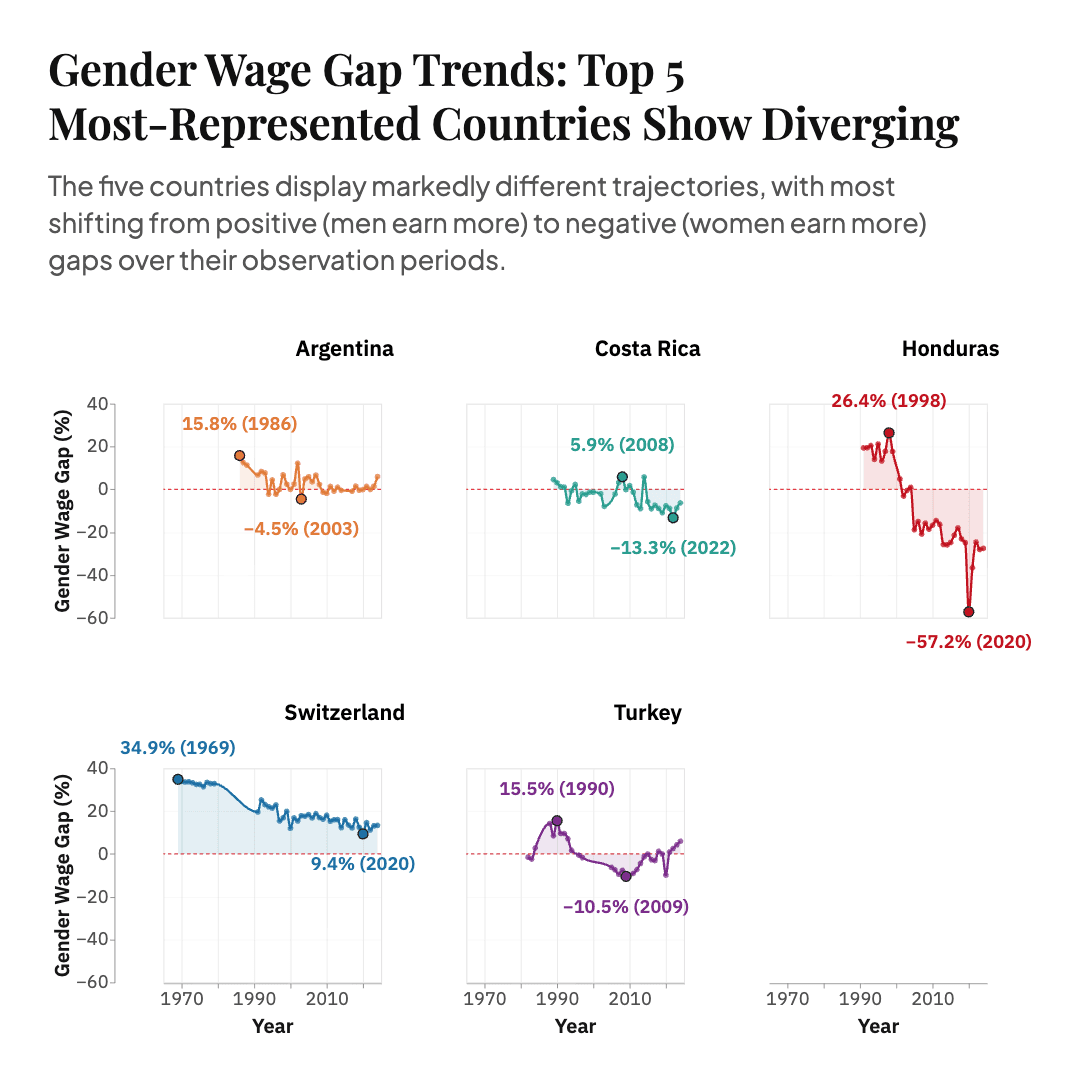
Gender Wage Gap Trends: Top 5 Most-Represented Countries Show Diverging Trajectories · Generated by Maya using the ILO Gender Wage Gap dataset via Our World in Data
↓ Download report PDFDataset
Gender Wage Gap — ILO
Via Our World in Data
Key Insight
"Four of five countries have crossed into negative territory — meaning women now out-earn men on this metric. That challenges the assumption that gender wage gaps universally favour men."
RESEARCH · Deep Dive
Dr. James
Public Health Researcher
He had a hypothesis about sleep and stress.
He needed the data to either confirm it — or complicate it.
How Dr. did it
The Question
Dr. James skipped the suggested questions entirely. He already knew what he wanted to test. He typed: "Is there a relationship between occupation type and average sleep duration, and does stress level mediate this?" One question. Two variables. A hypothesis worth testing.
The Discovery
The chart that came back was striking. Occupations sorted by sleep duration, with stress level encoded as a diverging colour scale — blue for low stress, red for high. The colour gradient almost perfectly mirrored the bar length.
Engineers averaged 8.0 hours of sleep with a mean stress of 3.9. Sales Representatives averaged 5.9 hours with a stress of 8.0. A 2.1-hour gap, almost entirely explained by stress. The mediation effect he'd hypothesised was visible without running a single regression.
The Refinement
The auto-generated insight was close — but not precise enough for Dr. James's research brief. He refined it with AI and prompted the tool to rewrite the content in his own academic register.
He added nuance: that Nurses appeared as an outlier — high stress but buffered by unusually high physical activity levels. That Doctors' stress was partially masked by age skew in the dataset. The chart stayed. The words became his.
The Outcome
He exported as PDF. The chart and his refined insight dropped cleanly into his research brief. Ten minutes from upload to a publication-ready visual that made the argument for him.
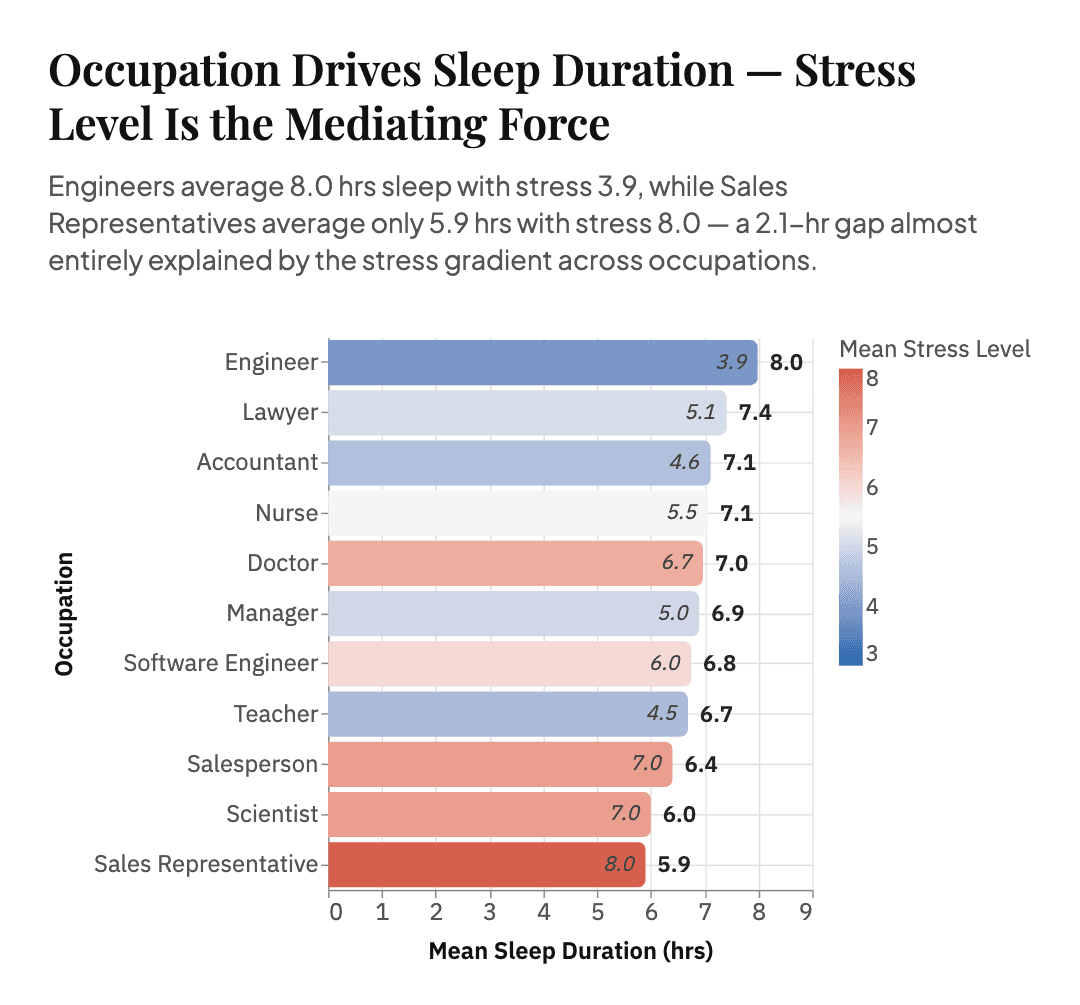
Occupation Drives Sleep Duration — Stress Level Is the Mediating Force · Generated by Dr. James using the Sleep Health & Lifestyle Dataset · Kaggle
↓ Download report PDFDataset
Sleep Health & Lifestyle Dataset
+ Institutional Cohort Extension
Key Insight
"The stress-sleep relationship is strongly negative: as mean stress rises from 3.9 to 8.0, mean sleep duration falls from 8.0 to 5.9 hours — a 2.1-hour gap almost entirely explained by the stress gradient across occupations."
POLICY · Decision
Priya
Policy Analyst · International Affairs Think Tank
She'd been arguing for months that education spending doesn't guarantee education access.
She needed one chart to end the debate.
How Priya did it
The Question
Priya uploaded nearly seven megabytes of World Bank education data — 272 countries, 25 years of indicators.
One suggested question matched her argument exactly: "Which countries show the biggest gap between education expenditure and enrolment outcomes?" She clicked it.
The Discovery
The chart surfaced what she'd suspected — but made it undeniable. Countries like Liechtenstein, Kazakhstan, and Sri Lanka achieved high enrolment on modest budgets. Lesotho, Djibouti, and Cuba spent relatively more but showed far lower enrolment ratios.
The gap wasn't random. It was structural. The countries on the negative end weren't the ones anyone expected.
The Refinement
Priya asked a follow-up: show only the top 5 and bottom 5 — the ten countries where the gap was most pronounced. The chart tightened. She moved the labels inside the bars, made them white and bold, and adjusted the spacing so every number was clearly readable.
The Outcome
She exported as PNG and published the morning of a major World Bank education summit. The chart didn't just illustrate her argument. It made it impossible to dismiss.
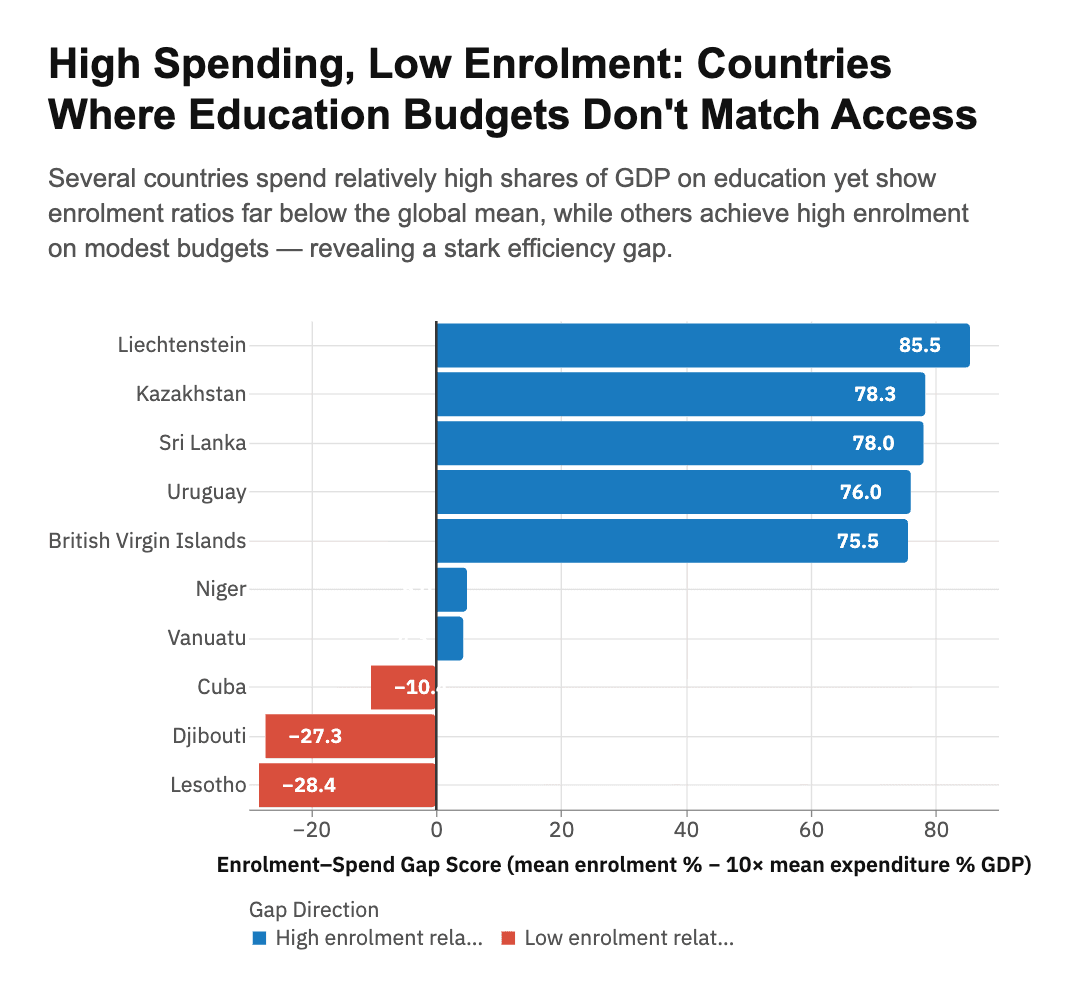
High Spending, Low Enrolment: Countries Where Education Budgets Don't Match Access · Generated by Priya using World Bank Education Statistics · data.worldbank.org
↓ Download report PDFDataset
World Bank Education Statistics
Government Expenditure & Enrolment Ratios
Key Insight
"Countries with spending above 4% of GDP but enrolment below 70% are the priority cases — additional spending is unlikely to improve access without structural reform."
Your Turn
You have data worth telling.
What’s your story?
Every chart on this page started with a file and a question. Yours is waiting.
No code. No data team. No waiting.